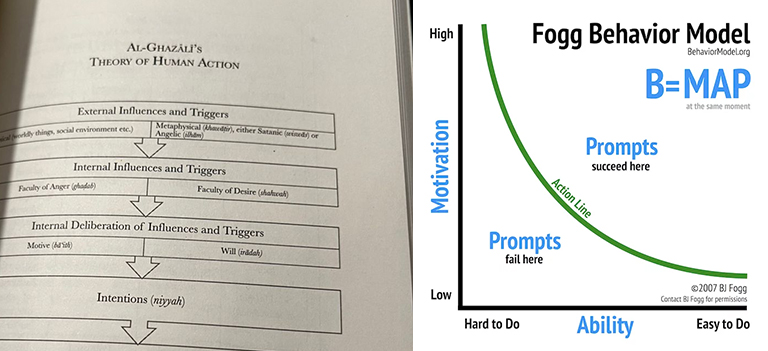
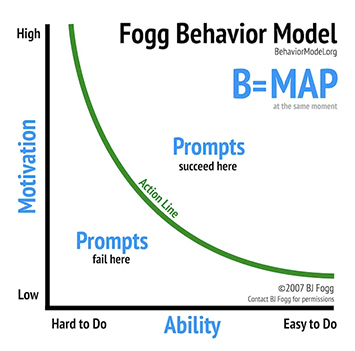
Today has been quite busy writing a research proposal that needs to be submitted next week. While going through my old proposals, I came across one submitted last year. In short, this proposal attempted to integrate a behavior change model and a persuasive design model into “context-aware” technological features to encourage congregational prayer. It was my first attempt at exploring the religious domain.
The reviewer’s comments on this proposal were quite interesting and raised many new questions. The emergence of these questions is not necessarily a bad thing, on the contrary, it is a blessing for a researcher.
One of the comments stated:
“The researcher should seek advice from religious scholars. Can this method be used? To what extent can it be applied? In my view, the act of performing prayer stems from faith (iman). If faith is weak, one will forget. If faith is strong, no matter how busy, one will prioritize it. Is the context aware and persuasive method appropriate in this case?”
This comment indeed has a valid basis.
The suitability of behavior change frameworks or any other theories of a secular nature that separate religious, spiritual, and metaphysical elements is questionable when implemented in technology aimed at encouraging religious practices of a spiritual nature, such as prayer.
There are already research domains and concepts that attempt to integrate technology with religion, such as “Digital Religion” and “Technomoral.” Several Western universities have even established dedicated research centers for this domain:https://www.technomoralfutures.uk/
Much work and research have been conducted there on the philosophy of technology and ethics. However, when discussing philosophy and ethics, these areas are closely tied to worldviews. Naturally, studies applying a Western secular worldview will be framed as “universal” and referenced by subsequent researchers.
But what about Islam?
Returning to that proposal, several questions arise:
-
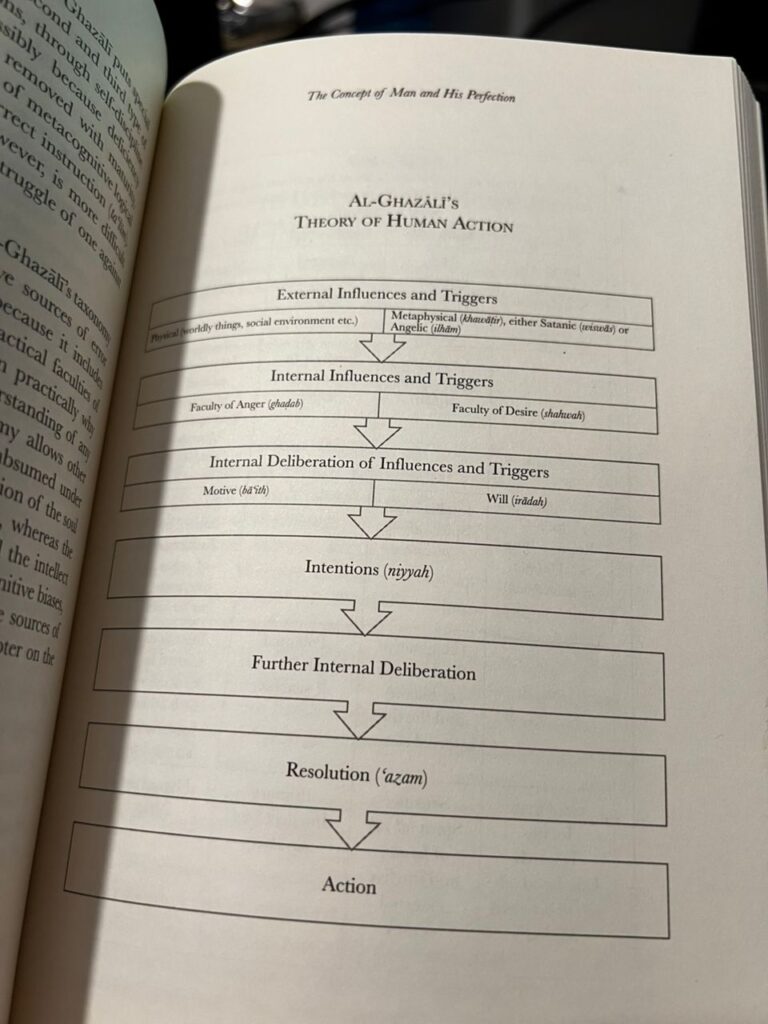
How can behavior change frameworks or other theories based on religion, such as Al Ghazali’s Theory of Human Action, which involves spiritual and metaphysical elements, be translated into technology design?
In the Islamic context, integrating technology into the religious domain requires deep scrutiny because it involves matters of Islamic rulings (ahkam), spirituality, and metaphysics, not merely outward actions. One possible approach at this early stage is to develop a technology design framework grounded in the Quran and Hadith, aligned with the maqasid al shariah. For example, the Hadith in which the Prophet ﷺ advised that when visiting someone’s home, one should greet (give salam) and ask permission up to three times; if permission is not granted to enter, one should leave. Could such a hadith on visitation etiquette be translated into a notification feature, for instance? (Of course, this would require consultation with religious scholars and experts.)
If such a framework could be translated into technological features, another question arises:
-
How, and with what indicators, can we measure the effectiveness of such technology in strengthening spiritually oriented practices according to the religious understanding?
In research, determining these success or effectiveness indicators is crucial for assessing whether the hypothesis has been achieved. This is especially true in technical fields such as information technology, where research typically emphasizes empirical evidence. Yet no technology can measure sin, reward (pahala), sincerity, and so on.
If spiritual and metaphysical indicators are excluded, then how would Islamic technology differ from other secular technologies? Does the concept of Islamization of technology exist?
Answering these questions requires exploring and engaging with many other branches of knowledge, including religious sciences such as tafsir, hadith, and fiqh, as well as fields like the philosophy of Islamic science and epistemology, to explore the Islamic worldview and thought framework.
References:
- Figure 1: Fogg Behavior Model (https://behaviordesign.stanford.edu/…/fogg-behavior-model)
-
Figure 2: Al Ghazali’s Theory of Human Action (Al Ghazali and Academic Excellence: The Art of Soul-Based Learning, Muhammad Hasanul Arifin Zawawi, 2019)